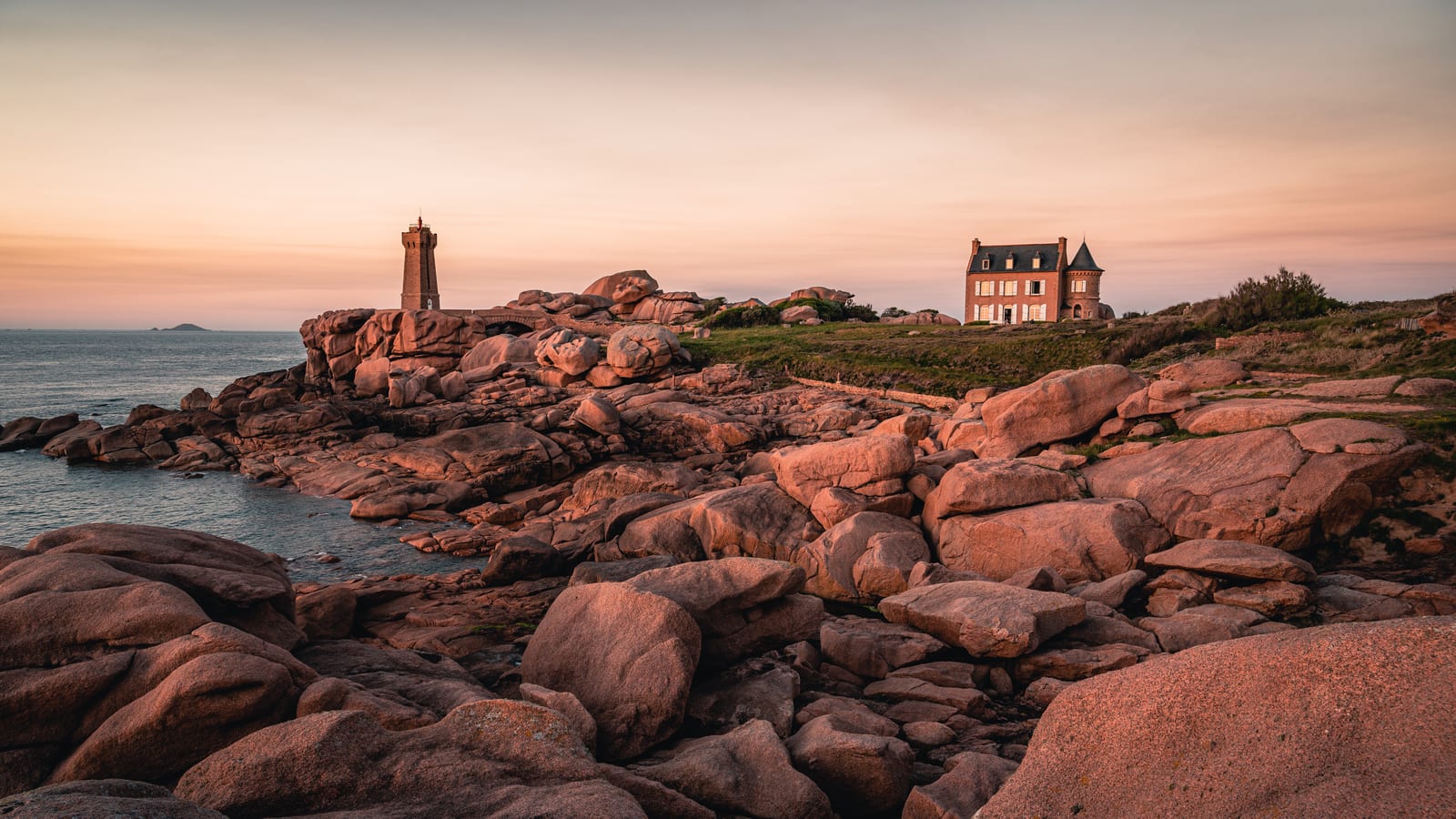
The Pink Granite Coast stretches for approximately 16 km along the northern Brittany shoreline, from Perros-Guirec in the east to Trébeurden in the west, passing through Trégastel. It is one of only three stretches of pink granite coastline in the world. The D788 connects all three towns in well under an hour of pure driving, but the coastline rewards time spent out of the car — particularly on the Sentier des Douaniers coastal path between Perros-Guirec and Ploumanac'h.
WHERE IS IT?
The Pink Granite Coast at a glance
The Pink Granite Coast runs along the northern shoreline of the Côtes-d'Armor department, between Perros-Guirec and Trébeurden, just west of the town of Lannion. The coastline is approximately 16 km long and passes through four municipalities: Trébeurden, Pleumeur-Bodou, Trégastel and Perros-Guirec. The village of Ploumanac'h, often described as the heart of the coast, is part of the commune of Perros-Guirec.
The area is reachable from both UK ferry arrival ports. Saint-Malo lies to the east and Roscoff to the west. If the Pink Granite Coast is the focus of your trip, Roscoff is generally the more convenient arrival port; from Saint-Malo, it is a longer drive. Use our Route Finder to compare the complete journey from your home to the coast.
THE ROUTE
How to drive the Pink Granite Coast
The most practical approach is to drive between the main towns on the D788 and park at each stop, rather than attempting to follow every inch of coastline by car. The roads are ordinary departmental routes — useful for getting between stops, but not scenic drives in themselves.
Suggested order, travelling west:
- 1. Perros-Guirec — start at Trestraou beach or the harbour.
- 2. Ploumanac'h — park and walk the Sentier des Douaniers.
- 3. Trégastel — approximately 10 km west of Perros-Guirec.
- 4. Trébeurden — the western end of the Pink Granite Coast.
The pure driving for the whole stretch takes well under an hour. The real time — and the point of the trip — is spent parked and on foot. Allow a full day if you want to walk a section of the coastal path and explore at least two of the towns.
STOP 1
Perros-Guirec
Perros-Guirec is a family seaside resort and watersports base, built on a rocky peninsula with a mix of scenic coastal roads and fine sandy beaches. Brittany Tourism describes it as having 13 km of coastline and three sandy beaches, with Trestraou being the principal beach. The harbour is the departure point for boat trips to the Sept-Îles archipelago, one of France's most important seabird reserves.
Trestraou has a rescue station during the summer season, and the beach is backed by a promenade with restaurants. It is a practical place to start the day — parking, facilities and food are all close at hand.
STOP 2
Ploumanac'h
Ploumanac'h is the heart of the Pink Granite Coast. The village was voted France's favourite village in 2015, and the pink granite rocks here are the coast's defining feature. The Sentier des Douaniers coastal path runs between Perros-Guirec and Ploumanac'h — this is the stretch that makes the trip, and it is better walked than driven (see below).
Two landmarks stand out. The Saint-Guirec Oratory is a 12th-century shrine on the beach at Ploumanac'h, associated with local maritime legends. It is a shrine, not a chapel, and is surrounded by the sea at high tide. The Phare de Ploumanac'h (also known as the Men Ruz lighthouse) is a 15-metre pink granite tower built in 1860, standing at the entrance to the harbour.
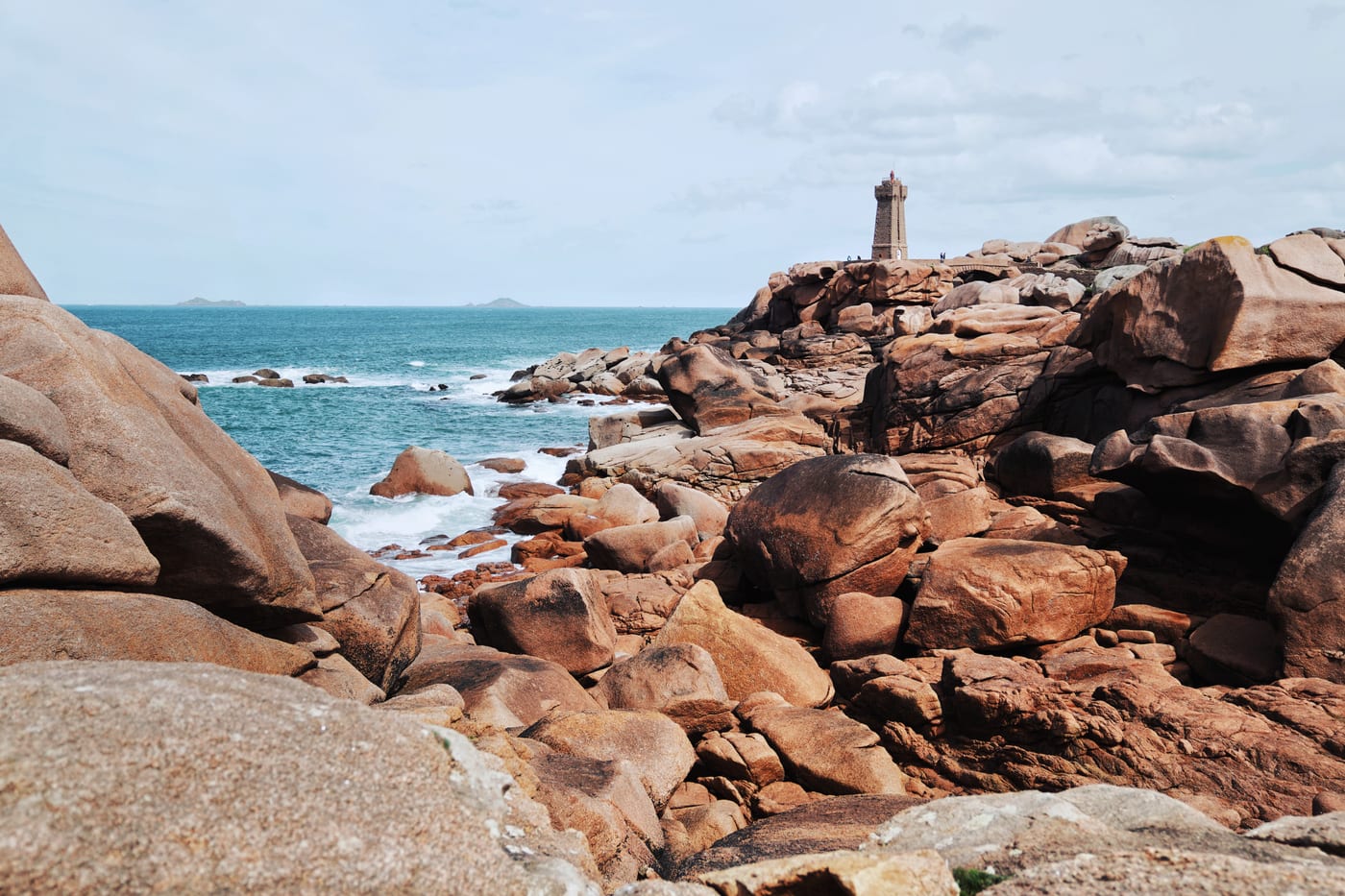
You can also explore the Pink Granite Coast by kayak, which offers a perspective on the rock formations that the coastal path cannot match.
STOP 3
Trégastel
Trégastel lies approximately 10 km west of Perros-Guirec, in the heart of the pink granite coastline. The commune has 12 sandy beaches, including Coz-Pors, which is particularly suited to families. The Aquarium Marin de Trégastel, located near Coz-Pors beach, is built into the pink granite rocks and offers an introduction to the region's marine life.
The Presqu'île Renote, a small peninsula connected to the mainland, is one of the area's most distinctive features and is worth a short walk.
STOP 4
Trébeurden
Trébeurden is a former sardine port at the entrance to Lannion Bay, at the western end of the Pink Granite Coast. The Pointe de Bihit headland offers panoramic views, and at low tide you can walk across to Île Milliau, a small island that takes about an hour to walk around and contains a prehistoric gallery grave.
WALK, DON'T DRIVE
The Sentier des Douaniers
The section of the Sentier des Douaniers (GR34) between Perros-Guirec and Ploumanac'h is the most rewarding part of the Pink Granite Coast, and it cannot be experienced from a car. The path is approximately 4 km one way — 8 km round trip — and is rated moderate rather than easy, with some rocky and uneven sections. Allow 3 to 4 hours including stops at viewpoints.
You can start from either end: Trestraou beach on the Perros-Guirec side, or from Ploumanac'h itself. The path passes the Phare de Ploumanac'h and the Saint-Guirec Oratory, and the pink granite formations are at their most striking from this vantage point.
This is the section to prioritise if you only have time for one walk. The broader GR34 continues along the Côtes-d'Armor coast, but the Perros-Guirec to Ploumanac'h stretch is the most famous and accessible.
LANDMARK
Château de Costaérès
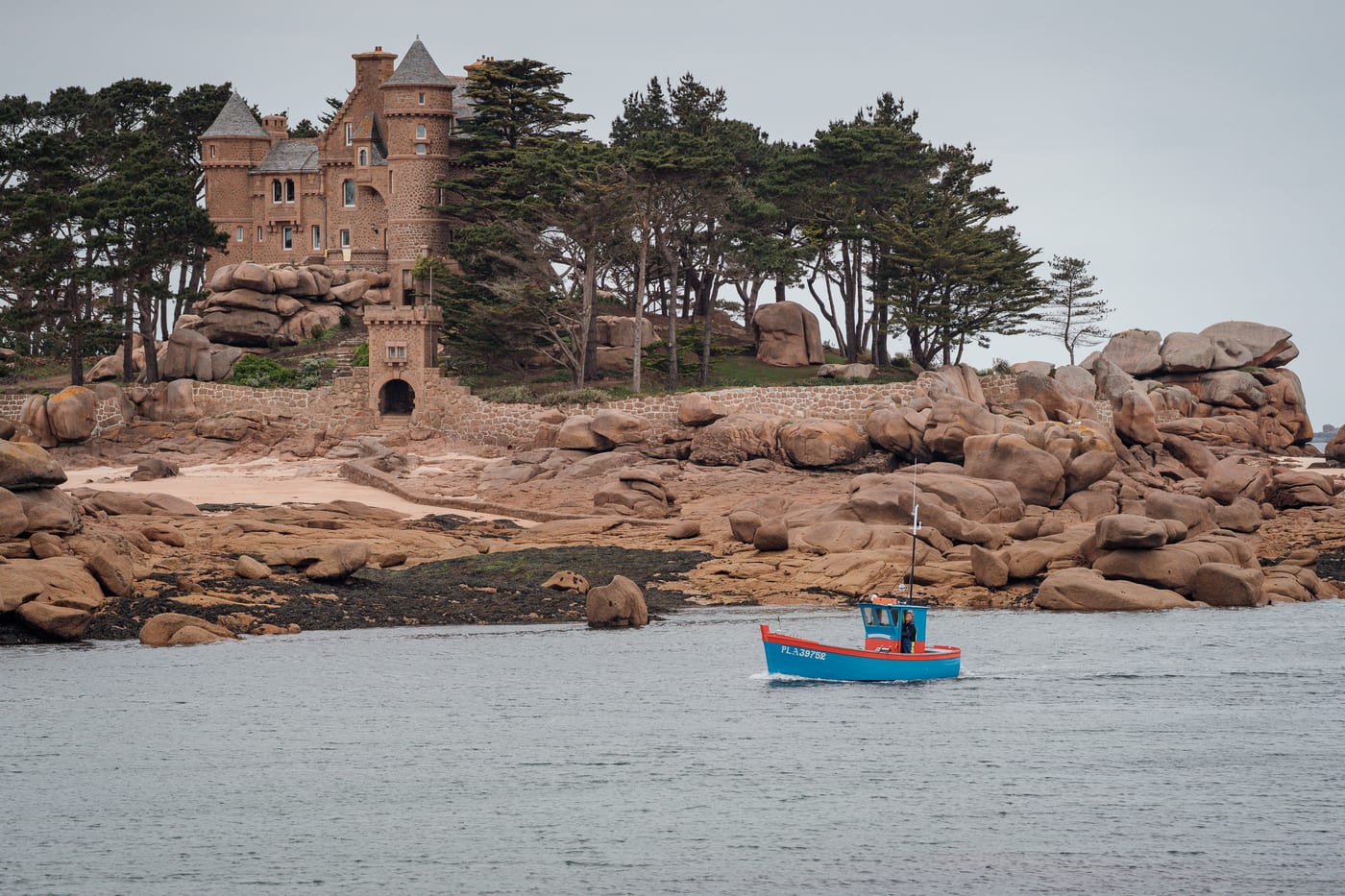
The Château de Costaérès is a neo-Gothic château built in 1896 on a private tidal island between Ploumanac'h and Trégastel. It is privately owned and not open to the public, but it is one of the most photographed landmarks on the coast and is visible from the Sentier des Douaniers and from the water. Its pink granite construction blends with the surrounding rocks.
PRACTICAL TIPS
Driving and parking
- Park and walk rather than driving every section. The driving is short; the walking is the point. The Sentier des Douaniers between Perros-Guirec and Ploumanac'h is the section to prioritise on foot.
- Check tide times before you go. The coastline changes dramatically between high and low tide, and some features — such as the Saint-Guirec Oratory and the causeway to Île Milliau — are affected by the tide.
- Arrive early in peak season. Parking at popular spots like Ploumanac'h fills up quickly on sunny summer days.
- Bring layers and walking shoes. The coastal path is rocky in places, and Brittany's coastal weather can change quickly.
- The pink granite is most photogenic in early morning or late afternoon light, when the warm tones of the rock are most pronounced.
WHEN TO GO
Best time to drive the Pink Granite Coast
The best time to drive the Pink Granite Coast is from spring to early autumn, when the weather is warmer and facilities are open. Summer is the busiest period; if you want fewer crowds, spring and autumn are quieter and the light can be excellent. The colour of the granite is most striking in early morning or late afternoon, when the warm tones of the rock intensify against the sea.
Check the marine forecast, wind and tide conditions before setting out, regardless of the season. Conditions on the northern Brittany coast can change, so choose a route appropriate to the forecast and your experience.
GETTING THERE
Reaching the Pink Granite Coast from the UK
The Pink Granite Coast is reachable from both UK ferry ports. Saint-Malo lies to the east and Roscoff to the west. If the Pink Granite Coast is the focus of your trip, Roscoff is generally the more convenient arrival port; from Saint-Malo, it is a longer drive west across the region.
Use our Route Finder to compare the UK drive, ferry crossing and onward journey to the coast as a single trip.